
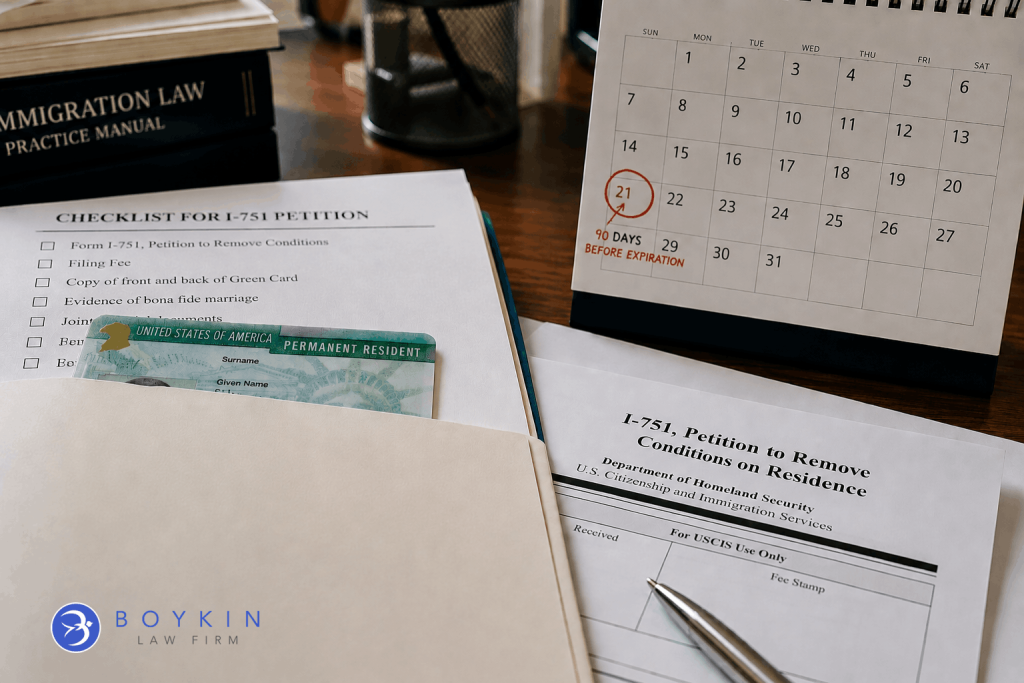
What Is a Conditional Green Card? Removing Conditions Explained
Holding your green card for the first time is usually a moment of profound relief. After months or even years of paperwork, background checks, and interviews, you finally have the legal right to live and work in the United States. But as you look at the plastic card in your hand, you might notice a surprisingly close expiration date.
That approaching date often brings the anxiety rushing back. The realization that your hard-won status might be temporary can feel overwhelming, especially if your personal circumstances have changed since the day your application was approved. You are left wondering what steps you must take to secure your future in the country, when exactly you need to act, and what happens if you make a mistake.
You do not have to live in fear of an expiring card. The process of transitioning from a temporary status to a permanent state of peace of mind is a well-established legal path. Below, we provide clear, reliable answers about what your status means and exactly what you must do to protect it.
What Is a Conditional Green Card?
A conditional green card is a two-year permanent resident card issued primarily to immigrants whose status is tied to a marriage that was less than two years old on the day permanent residence was granted, as well as to certain immigrant investors. It gives you nearly all the same rights and responsibilities as any other green card holder, with one major exception: the status expires.
When you hold this card, U.S. Citizenship and Immigration Services (USCIS) considers you a conditional permanent resident. For spouses, this status was created to prevent marriage fraud by allowing the government a second look at the relationship two years down the line. If you want to remain in the United States permanently, you must take active steps to prove your eligibility before the two years run out.
Conditional Green Card vs. Permanent Green Card
While both cards grant you the right to live and work legally in the U.S., they are fundamentally different in how you maintain them. The table below outlines the primary distinctions.
| Feature | Conditional Green Card | Permanent Green Card |
| Validity Period | Valid for exactly 2 years. | Valid for 10 years. |
| Renewability | Cannot be renewed; conditions must be removed. | Can be renewed indefinitely. |
| Rights Granted | Full rights to work, live, and travel in the U.S. | Full rights to work, live, and travel in the U.S. |
| Required Next Step | File a petition to remove conditions before expiration. | File a form to renew your physical card before it expires. |
Who Gets a Conditional Green Card?
You might wonder exactly who gets a conditional green card and why the government issues them. USCIS primarily grants this two-year status to two distinct groups of immigrants:
- Spouses of U.S. Citizens or Permanent Residents: If you obtained your status through marriage to a U.S. citizen or lawful permanent resident, you fall into this category. You will see specific category codes on your physical card. CR1 is used if you entered the U.S. through consular processing, and CR6 is used if you adjusted your status from within the United States.
- EB-5 Immigrant Investors: Foreign nationals who invest significant capital in a U.S. commercial enterprise that creates jobs also receive a two-year conditional card. They must prove their investment sustained the required jobs before they can secure permanent status.
Why You Can’t Simply Renew a Conditional Green Card
A common misconception is that you can just apply for a conditional green card renewal. This is a myth. You cannot simply renew a conditional card using Form I-90, which is the standard application used to renew a regular 10-year card.
Because your underlying status itself expires, filing a standard renewal form will result in a rejection and lost filing fees. The only path forward is undergoing the formal removal of conditions.
How to Remove the Conditions on Your Green Card
To permanently secure your life in the United States, you must formally ask the government to remove the conditions on your green card. This is not an automatic process. It requires filing a detailed petition with USCIS that demonstrates you still meet the legal requirements for permanent residence. The path you take depends entirely on your marital situation and whether you are filing as a spouse or an investor. (EB-5 investors use Form I-829, while marriage-based residents use the form discussed below)
Form I-751 and the 90-Day Filing Window
For a marriage-based conditional resident, the required petition is Form I-751 (Petition to Remove Conditions on Residence). If you are still married and living with your spouse, you must file this form jointly during a very strict 90-day filing window.
This window opens exactly 90 days before the expiration date printed on your green card. If you file even one day before this 90-day window begins, USCIS will reject your petition and send it back. Once USCIS accepts your timely petition, they will send you a receipt notice that legally extends your status while you wait for a decision.
Filing Jointly vs. Requesting a Waiver
In most cases, you and your petitioning spouse file Form I-751 together, signing the document jointly to confirm your marriage is ongoing. However, life is unpredictable, and remaining married is not always possible. If you find yourself facing a conditional green card divorce or separation, you are not automatically out of options.
You may request a waiver of the joint filing requirement, allowing you to file Form I-751 on your own. Unlike joint petitions, waiver petitions are not restricted to the 90-day window and can be filed at any time before a final order of removal. You can request a waiver if you meet one of the following grounds:
- Your marriage was entered in good faith, but ended in divorce or annulment.
- Your petitioning U.S. citizen or permanent resident spouse has died.
- You or your child was battered or subjected to extreme cruelty by your petitioning spouse.
- The termination of your status and removal from the United States would cause you extreme hardship.
Evidence That Proves a Good-Faith Marriage
Whether you file jointly or request a waiver based on divorce, USCIS is evaluating the same core question: was your marriage entered into in good faith (bona fide), or was it solely for an immigration benefit? You must submit strong, organized evidence proving you built a life together. Crucially, this evidence should focus on the period since your original green card was approved.
- Financial Records: Joint bank accounts, joint credit card statements, and shared liabilities like loans or tax returns.
- Property Documents: A joint lease agreement or a mortgage showing both of your names on your shared residence.
- Family Additions: Birth certificates of any children born to the marriage.
- Insurance Policies: Health, life, or auto insurance showing you are on the same policy or listed as each other’s beneficiaries.
- Life Together: Photographs from holidays, family gatherings, and joint travel records (itineraries, boarding passes).
- Third-Party Affidavits: Sworn statements from friends, family, or colleagues who can testify to the genuine nature of your relationship.
How Much Does Removing Conditions Cost?
As of 2026, the removal of the conditions fee for Form I-751 is approximately $750 under the 2024 USCIS fee rule. For most filers, this total includes the cost of biometrics, meaning you do not have to pay a separate fingerprinting fee.
Because government filing fees are subject to change, you should never guess the amount. Before mailing your petition, always direct yourself to the official USCIS Fee Calculator on the government website to verify the exact, current cost required for your specific filing category.
How Long Does Removal of Conditions Take?
The waiting period for these petitions requires deep patience. As of 2026, the removal of conditions timeline for many I-751 petitions ranges from roughly 31 to 38.5 months. Your specific wait time will vary based on which USCIS service center processes your case.
Unfortunately, there is no premium processing or expedited option available for Form I-751. While the wait is long, you do not lose your rights while the case is pending. You can check the official USCIS processing times tool online to get a more accurate estimate for your specific service center.
Can You Travel and Work While Your Case Is Pending?
Yes, you retain your right to work and travel on a conditional green card even after the physical card expires, provided you filed your petition on time. When USCIS accepts your Form I-751, they issue a receipt notice (Form I-797C). This crucial document automatically extends your conditional permanent resident status and your work authorization for 48 months beyond the card’s original expiration date.
If you plan to travel internationally or if you are starting a new job, you must carry the correct documentation to prove your extended lawful status.
- Your expired conditional green card.
- Your original Form I-797C receipt notice extending your status.
- Your valid, unexpired foreign passport.
- If your receipt notice gets lost or is close to expiring, you can request an ADIT stamp (temporary evidence of status) in your passport from a local USCIS field office.
What Happens If You Miss the Filing Deadline?
Missing the deadline to file Form I-751 is a high-stakes error. If the 90-day window passes and your 2-year green card expires without a petition on file, your conditional resident status automatically terminates on the two-year anniversary of the date you were granted residence. You immediately become removable from the United States, and USCIS may issue a Notice to Appear in immigration court.
However, a legal mechanism exists to correct this if you act quickly. USCIS may accept a late joint petition if you provide a strong written explanation demonstrating “good cause” and extenuating circumstances beyond your control that prevented you from filing on time. Because your status is now formally in jeopardy, handling a late filing requires a highly strategic legal approach.
How Boykin Law Firm Can Help With Your I-751
Facing an expiring green card or managing a complicated waiver case is not something you should do alone. At Boykin Law Firm PLLC, an immigration attorney is ready to guide you safely through this critical transition. We are a boutique firm that prioritizes warm, human-rights-focused, and culturally sensitive representation. You are never just a case file to us.
We understand the deep anxiety that comes with proving your life to the government. We meticulously organize your evidence to build an undeniable case, carefully manage complex divorce or abuse waivers, and respond decisively to any Requests for Evidence. If USCIS requires an interview, we prepare you thoroughly so you walk into the room with confidence. From your first filing to your final approval, you will have a dedicated advocate focused on protecting your family’s future in the United States.
Schedule your personalized consultation with Boykin Law Firm today.
Frequently Asked Questions
| Question | Answer |
| Can I apply for U.S. citizenship while my Form I-751 is still pending? | Yes. You can file Form N-400 while your I-751 is pending if you meet the other eligibility requirements, for example, three years as a permanent resident if you are married to and living with a U.S. citizen. USCIS often holds a combined interview for both. |
| What if my conditional green card marriage is genuine, but my spouse and I have separated? | Separation is a gray area. You generally cannot use a divorce-based waiver while still legally married, but a joint petition needs your spouse’s cooperation. You may have to wait for the divorce to finalize or qualify under another waiver ground, so speak with an attorney before filing. |
| Can my children be included on my I-751 petition? | Yes, if they received conditional resident status at the same time as you or within 90 days of you. If they got their status later, they must file their own separate petitions. |
| My green card says IR6, not CR1 or CR6. Do I have to remove conditions? | No. IR6 is an “Immediate Relative” code, meaning you were married for two or more years when your status was approved. That is a permanent 10-year card, not a conditional one, so you do not file Form I-751. |
| What triggers a USCIS interview for an I-751 petition? | USCIS schedules interviews frequently and can only waive one when your evidence is strong and shows no signs of fraud. Expect an interview if your evidence is thin, you are filing a divorce waiver, or your file has inconsistencies. |